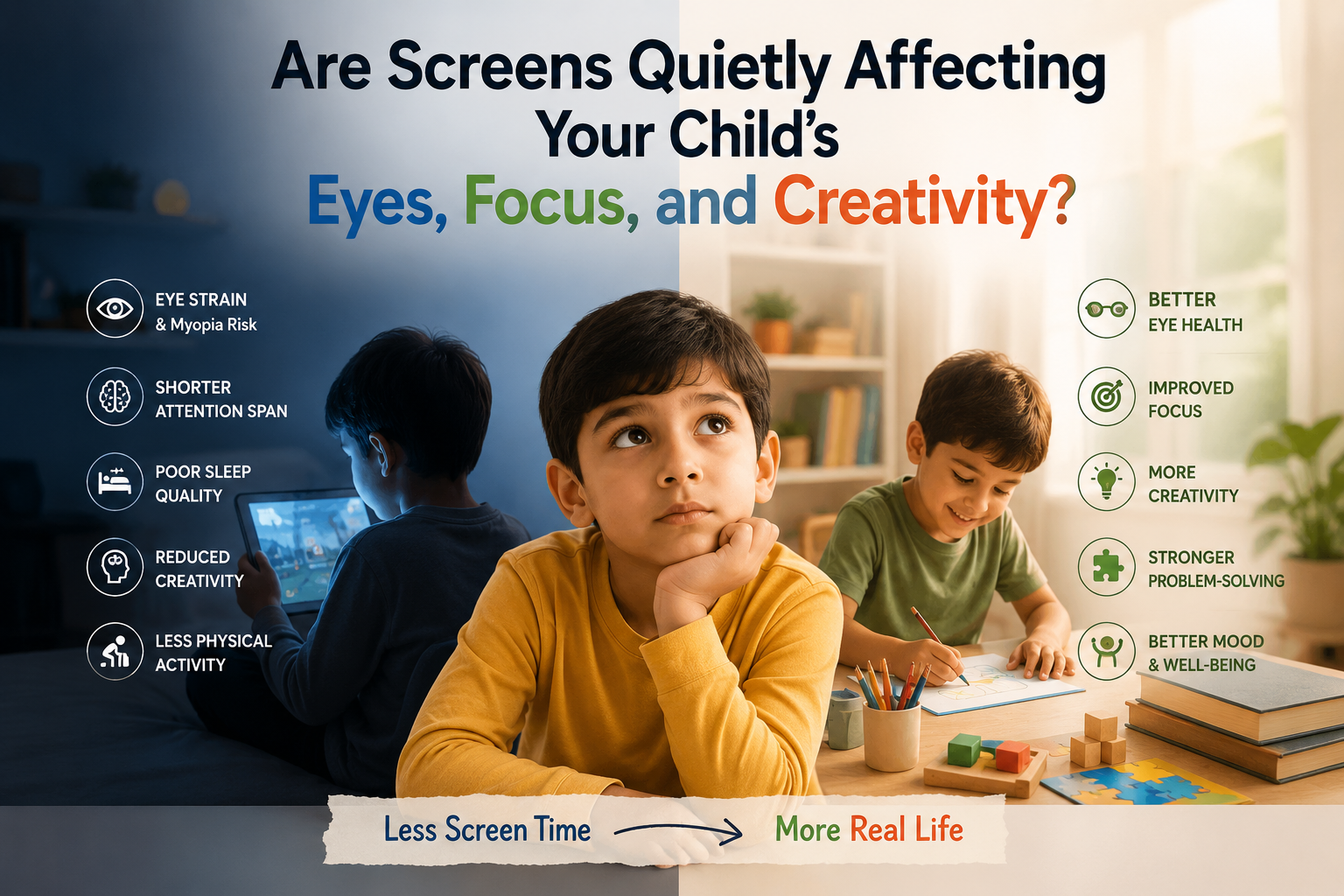
Children today spend more time on screens than any previous generation. While technology offers many benefits, growing concerns about eye health, attention span, creativity, and independent play have many parents searching for healthier alternatives. Discover what current research suggests and explore practical screen-free activities that help children learn, create, and thrive.
Published June 2026 • 8 min read
By Tau Digital Works
Looking for ready-to-use screen-free activities?
Explore the Screen-Free Learning BundleThe conversation around children's screen time is no longer just about entertainment. Increasingly, researchers, eye specialists, psychologists, and public health organizations are studying how modern screen habits may influence various aspects of childhood development, including vision, attention, sleep, emotional well-being, and social interaction.
One of the most widely discussed concerns is the growing prevalence of myopia (short-sightedness). Recent global research published in the British Journal of Ophthalmology found that approximately one in three children and adolescents worldwide are already affected by myopia. Researchers project that the number of children and teenagers with myopia could approach 600 million by 2030.
The risk increases significantly with age. By 2030, experts estimate that around 43% of teenagers worldwide could be affected by myopia, while prevalence among younger children may reach approximately 21%. Researchers believe this rapid increase cannot be explained by genetics alone and is closely linked to lifestyle changes, including increased screen use, prolonged close-up activities, reduced outdoor play, and less exposure to natural sunlight.
However, concerns about children's screen habits extend beyond eyesight. Researchers are also examining how excessive screen use may affect emotional well-being. Some studies suggest that heavy screen use may be associated with higher levels of anxiety, irritability, low mood, and emotional difficulties in certain children and adolescents.
Experts have also observed that children who are already feeling stressed, lonely, or overwhelmed may increasingly turn to digital entertainment for comfort. Over time, screens can become a primary coping mechanism, potentially reducing opportunities for real-world interaction, active play, creative exploration, and healthy emotional development.
While screens are not the sole cause of these challenges, the growing body of research highlights the importance of balance. Technology can be a valuable tool when used thoughtfully, but many experts agree that children also need regular opportunities to explore, create, move, socialize, and learn beyond a screen.
Childhood is a period of exploration, imagination, and discovery. Through drawing, storytelling, building, experimenting, and creative play, children learn how to express themselves and make sense of the world around them.
When much of a child's free time is spent watching videos, scrolling through content, or playing highly structured digital games, there may be fewer opportunities to actively create. Instead of generating ideas, children may spend more time consuming ideas created by others.
Creative activities help children develop imagination, confidence, adaptability, and problem-solving abilities. They encourage children to think independently, explore possibilities, and develop skills that remain valuable throughout life.
In today's digital world, entertainment is available almost instantly. With just a few taps, children can access videos, games, and endless streams of content designed to capture attention.
While this convenience can be enjoyable, it can also reduce opportunities for children to learn how to engage with unstructured time. Moments of boredom often encourage children to invent games, explore interests, create projects, ask questions, and use their imagination.
Learning how to manage boredom is an important life skill. It helps children become more resourceful, self-directed, and capable of creating meaningful experiences without constantly relying on external entertainment.
Many screen-based activities involve sitting for extended periods. As digital entertainment occupies a larger share of children's leisure time, opportunities for physical activity may naturally decline.
Running, climbing, jumping, exploring, and outdoor play support healthy physical development. Movement helps children strengthen coordination, balance, motor skills, and overall fitness.
Physical activity also contributes to emotional well-being, confidence, and energy levels. Active play allows children to interact with their environment in ways that screens simply cannot replicate.
Digital content is often designed to deliver quick rewards, fast-paced stimulation, and constant novelty. This can make slower activities feel less appealing by comparison.
Reading a book, solving a puzzle, building a model, completing a worksheet, or working on a creative project requires patience and sustained attention. These activities challenge children to remain engaged even when immediate rewards are not available.
Developing focus is important because many academic, creative, and real-world tasks require concentration over extended periods of time. Attention is a skill that grows through practice.
Social development is one of the most important aspects of childhood. Children learn communication skills through conversations, shared experiences, teamwork, and everyday interactions with family members, friends, and peers.
Face-to-face interaction teaches children how to listen, express themselves clearly, understand emotions, resolve disagreements, and work cooperatively with others.
While technology can help people stay connected, it cannot fully replace the learning that occurs through direct human interaction and real-world social experiences.
Growing up involves learning how to handle disappointment, frustration, boredom, uncertainty, and challenges. These experiences help children develop emotional resilience and self-control.
When entertainment, rewards, and stimulation are available instantly, children may have fewer opportunities to practice patience and persistence. Activities that require effort, waiting, or problem-solving can feel more difficult when instant gratification becomes the norm.
Developing emotional regulation helps children manage stress, overcome obstacles, build confidence, and respond to challenges in healthy and constructive ways.
The conversation about screen time is not only about quantity but also about quality. Some digital experiences can be educational, creative, and beneficial. Others may offer little learning value beyond short-term entertainment.
Many parents are becoming more selective about the content their children consume. Educational videos, learning platforms, and creative tools can support development, while endless scrolling, repetitive content, or age-inappropriate material may contribute little to long-term growth.
Understanding the difference between passive consumption and meaningful engagement can help families make more informed decisions about how technology fits into a child's daily life.
Every child is different, and there is no single rule that applies to every family. However, one thing remains clear: children benefit from a healthy mix of experiences. Alongside technology, they need opportunities to move, explore, create, imagine, solve problems, and connect with the people around them.
The goal is not to eliminate screens but to ensure they do not become the only source of entertainment, learning, or engagement. When children regularly participate in meaningful offline activities, they develop important life skills that support their growth, confidence, and overall well-being.
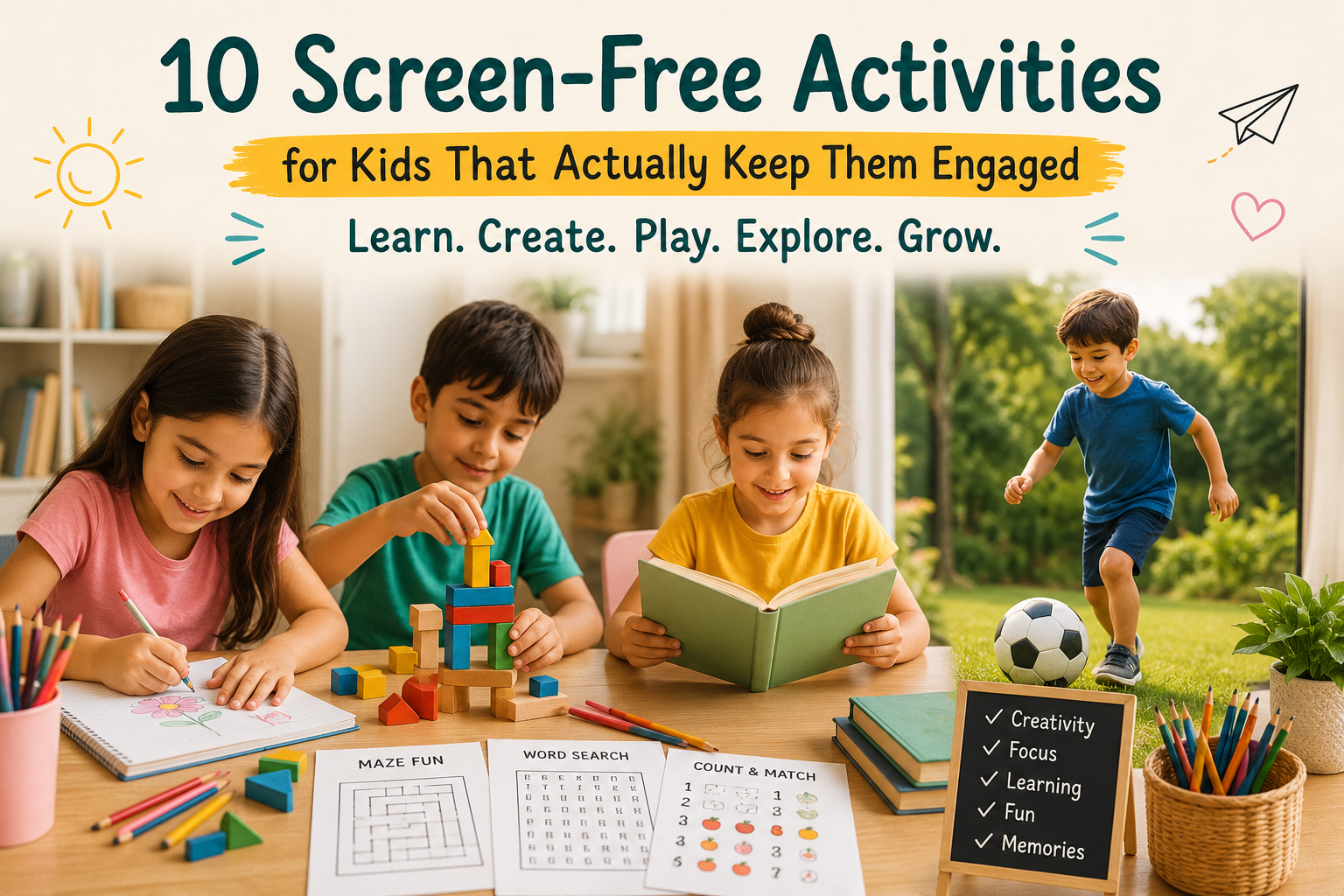
Fortunately, creating this balance does not have to be difficult. Many simple screen-free activities can keep children engaged while encouraging creativity, curiosity, and independent learning.
The key is not simply reducing screen time—it is replacing it with experiences that help children learn, explore, create, and grow. Even small changes can make a meaningful difference over time.
A nature scavenger hunt transforms an ordinary walk into an exciting learning adventure. Instead of simply asking children to spend time outdoors, provide them with a list of items to find, such as a smooth rock, a yellow flower, a feather, a leaf with an unusual shape, or something that smells pleasant.
This activity encourages children to observe their surroundings more carefully and develop curiosity about the natural world. It also promotes physical movement and outdoor exploration, which many experts believe play an important role in healthy childhood development.
Skills Developed: Observation, concentration, curiosity, problem-solving, and environmental awareness.
Parent Tip: Turn the activity into a photo challenge or create a simple point system to make it even more exciting.
Children naturally become more engaged when they see themselves at the center of a story. Instead of reading about someone else's adventure, imagine a story where your child becomes the hero who solves mysteries, explores magical worlds, helps others, or embarks on exciting learning journeys.
Personalized storytelling encourages children to use their imagination while building confidence and emotional connection with the story. When children see themselves as the main character, they often become more interested in reading, creative thinking, and storytelling activities.
Parents can create simple personalized stories at home by using their child's name, favorite hobbies, friends, pets, or dream destinations. For example, a child who loves space could become the captain of a mission to discover a new planet, while another child might become a detective solving a neighborhood mystery.
Today's AI tools also make it possible to create personalized story videos where children become the heroes of their own adventures. These stories can combine learning, creativity, and imagination while providing an engaging alternative to passive screen consumption.
Skills Developed: Creativity, language development, confidence, imagination, emotional connection, and communication.
Parent Tip: Ask your child, "If you could go on any adventure tomorrow, where would you go?" Then build a story around their answer. Children become much more engaged when they help create the story themselves.
Children naturally enjoy physical challenges. Using cushions, chairs, ropes, boxes, and other safe household items, create a simple obstacle course that children must navigate.
They might crawl under tables, jump between markers, balance along a taped line, or carry an object from one point to another. The goal is to make movement fun rather than structured exercise.
Obstacle courses encourage physical activity while also requiring children to plan, adapt, and solve problems as they move through different challenges.
Skills Developed: Coordination, balance, confidence, physical fitness, and problem-solving.
Parent Tip: Use a timer and encourage children to beat their own personal best rather than competing against others.
Reading becomes much more engaging when children actively participate in the story. Instead of simply reading a book, encourage them to become part of the adventure.
Ask questions such as: "What would you do if you were the main character?" or "How would you change the ending?" Children can also act out scenes, draw their favorite characters, or create a sequel to the story.
This approach transforms reading from a passive activity into an interactive experience that stimulates imagination and deeper thinking.
Skills Developed: Literacy, comprehension, creativity, empathy, and communication.
Parent Tip: Pause occasionally and ask open-ended questions to encourage imagination and deeper thinking.
Give children building blocks, cardboard boxes, paper cups, recycled materials, or any safe construction materials available at home. Then challenge them to build something specific, such as a bridge, tower, house, spaceship, or even an invention that solves a problem.
Building activities encourage children to experiment, test ideas, and learn through trial and error. They often discover that failure is simply part of the creative process, helping them develop resilience and confidence.
The best part is that there is no single correct answer. Every child can approach the challenge differently, which encourages originality and independent thinking.
Skills Developed: Problem-solving, creativity, engineering thinking, patience, and perseverance.
Parent Tip: Encourage experimentation and celebrate creative ideas, even if the final structure doesn't work perfectly.
The activities above can be wonderful ways to encourage creativity, movement, problem-solving, and independent thinking. However, many parents discover that the challenge is not finding one activity—it is consistently finding engaging, educational activities week after week.
Children naturally enjoy variety. An activity that feels exciting today may lose its appeal after a few days, leaving parents searching for new ideas, printable resources, learning exercises, and creative challenges.
Many parents eventually discover that while outdoor play, storytelling, reading, and creative projects are wonderful, children also benefit from structured learning activities they can complete independently. That is exactly why we created the Screen-Free Learning Bundle.
Rather than spending hours searching online for fresh activities, the bundle provides a collection of ready-to-use printable resources designed to keep children engaged while supporting learning, creativity, focus, and independent thinking.
Whether you are a parent looking to reduce screen time, a homeschooler seeking educational activities, or simply someone who wants meaningful alternatives to passive entertainment, the bundle offers practical resources that children can use again and again.
Explore the Screen-Free Learning Bundle →
Learning letters becomes much more exciting when children actively search for them in the world around them. Choose a letter and challenge your child to find objects that begin with that sound. For example, for the letter "B," they might find a book, ball, banana, or bag.
This simple activity helps children connect letters with real-world objects while strengthening early reading and phonics skills. Younger children can focus on identifying beginning sounds, while older children can practice spelling and vocabulary.
Skills Developed: Letter recognition, phonics awareness, vocabulary, and observation.
Parent Tip: Start with letters your child already knows to build confidence before introducing new sounds.
Age Group: 3–7 years
Turn everyday environments into a math adventure. Ask children to become "number detectives" and search for numbers around the house, on clocks, calendars, books, measuring cups, or packaging.
You can also challenge them to count objects, compare quantities, identify odd and even numbers, or create simple addition problems using items they find.
Skills Developed: Number recognition, counting, mathematical thinking, and problem-solving.
Parent Tip: Use everyday objects such as toys, fruits, or books to make counting and number recognition more meaningful.
Age Group: 4–8 years
Children often enjoy activities that feel like mini-missions or challenges. Printable worksheets can provide structured learning opportunities while still feeling fun and engaging.
Activities such as matching exercises, tracing pages, puzzles, observation games, word activities, and creative thinking challenges encourage independent learning while giving children a break from screens.
Skills Developed: Focus, concentration, fine motor skills, independent learning, and critical thinking.
Parent Tip: Keep sessions short and enjoyable. Consistent 10–15 minute activities are often more effective than long sessions.
Age Group: 3–8 years
Building positive habits can be turned into a game. Create a simple daily routine chart and allow children to track activities such as reading, brushing teeth, completing learning activities, helping around the house, or spending time outdoors.
Many children become more motivated when they can visually track their progress and celebrate small achievements. Over time, routine-building activities help create consistency and responsibility.
Skills Developed: Responsibility, independence, self-discipline, and time management.
Parent Tip: Focus on consistency rather than perfection. Small daily habits often lead to the biggest long-term improvements.
Age Group: 4–10 years
Designate a small area in your home as a learning station where children can access books, coloring activities, worksheets, puzzles, and creative supplies. Having a dedicated learning space encourages children to engage in educational activities independently.
The goal is not perfection but consistency. Even spending a short amount of time each day in a learning-focused environment can help children build positive habits and a lifelong love of learning.
Skills Developed: Independence, organization, focus, creativity, and self-directed learning.
Parent Tip: Rotate books, worksheets, and activities regularly to keep the learning station fresh and engaging.
Age Group: 3–10 years
A learning station becomes even more effective when children have access to a variety of age-appropriate educational resources. Printable worksheets, activity books, coloring challenges, routine trackers, and learning games can help keep the experience fresh while encouraging consistent learning habits.
The goal is not to eliminate screens completely. Technology can be educational, creative, and useful when used appropriately. The challenge is ensuring that screens do not replace the activities that help children develop creativity, confidence, focus, problem-solving abilities, and healthy social skills.
By providing meaningful alternatives such as outdoor exploration, storytelling, reading, creative projects, and structured learning activities, parents can help children build a healthier relationship with technology while supporting long-term development.
Technology has become a natural part of modern life, and screens will continue to play an important role in how children learn, communicate, and access information. The goal is not to remove technology completely or make parents feel guilty about screen use. Instead, the goal is to create a healthy balance that allows children to benefit from technology without missing out on the experiences that help them grow.
When children spend time exploring outdoors, building things, reading stories, solving problems, creating art, and interacting with the people around them, they develop skills that cannot be fully replicated by a screen. These everyday experiences help shape creativity, confidence, resilience, curiosity, communication skills, and independent thinking.
The encouraging news is that meaningful change does not require dramatic lifestyle changes. Small steps—such as introducing one screen-free activity each day, setting aside time for family interaction, encouraging outdoor play, or providing engaging learning opportunities—can gradually create healthier habits over time.
Every family is different, and there is no perfect formula. What matters most is being intentional about how children spend their time and ensuring they have opportunities to learn, create, explore, and discover the world beyond a screen.
Childhood is a unique and important stage of life. The experiences children have today help shape the adults they will become tomorrow. By creating space for curiosity, creativity, movement, learning, and real-world experiences, parents can help children build skills and memories that will last far beyond childhood itself.
If you're searching for educational alternatives to passive screen time, our Screen-Free Learning Bundle includes printable worksheets, learning activities, routine trackers, coloring pages, and skill-building exercises designed to keep children engaged while supporting independent learning.
There is no single answer that applies to every child. Experts generally recommend focusing not only on the amount of screen time but also on the quality of content, the child's age, and whether screen use is replacing important activities such as sleep, physical activity, learning, outdoor play, and social interaction.
Research suggests that increased time spent on screens and other close-up activities may be associated with a higher risk of myopia (short-sightedness) in children and adolescents. Eye specialists also encourage regular breaks, outdoor play, and healthy viewing habits to help support eye health.
Some of the most effective screen-free activities include outdoor exploration, reading, storytelling, arts and crafts, puzzles, building challenges, science experiments, educational worksheets, board games, and creative learning projects. Activities that encourage children to think, create, move, and solve problems often provide the greatest long-term benefits.
Many families find greater success by introducing enjoyable alternatives rather than focusing only on restrictions. Creating routines, scheduling screen-free periods, participating in activities together, and providing engaging alternatives can help children transition more naturally.
Educational content can provide meaningful learning opportunities when it is age-appropriate, interactive, and used in moderation. However, experts generally agree that even high-quality digital content should be balanced with real-world experiences such as reading, outdoor play, creative activities, and face-to-face interaction.
Printable worksheets can be an effective screen-free learning tool when they are engaging, age-appropriate, and balanced with other activities. They help children practice important skills such as reading, writing, problem-solving, concentration, and independent learning while reducing reliance on digital devices.
Outdoor play supports physical activity, creativity, social development, exploration, and overall well-being. Research also suggests that spending time outdoors may play an important role in supporting healthy eye development and reducing some of the risks associated with excessive indoor screen use.
Researchers continue to study the relationship between screen habits and attention. Many experts believe that constant exposure to fast-paced, highly stimulating content may make it more difficult for some children to remain engaged in slower activities such as reading, problem-solving, creative projects, and independent learning. Developing focus requires practice, and activities that encourage sustained attention can help children strengthen this important skill over time.
Recommendations vary depending on a child's age and the type of content being used. Many pediatric organizations encourage parents to prioritize real-world interaction, play, communication, and exploration during the early years of development. As children grow older, screen use can be introduced in age-appropriate ways while maintaining a healthy balance with offline activities and family interaction.
Many educators and child development experts believe that screen-free activities play an important role in fostering creativity. Activities such as storytelling, drawing, building, imaginative play, reading, problem-solving, and outdoor exploration encourage children to generate their own ideas rather than simply consuming content created by others. These experiences help develop imagination, curiosity, and independent thinking.
The information in this article is based on research and guidance from the following organizations: